Cerner was interviewing Silicon Valley giants to pick a storage provider for 250 million health records, one of the largest collections of U.S. patient data.
On Dec. 30, Andrew Bosworth, a longtime Facebook executive and confidant of Mark Zuckerberg, wrote a long memo on the company’s internal network. In the post, titled “Thoughts for 2020,” Mr.
Every minute of every day, everywhere on the planet, dozens of companies — largely unregulated, little scrutinized — are logging the movements of tens of millions of people with mobile phones and storing the information in gigantic data files.
Op-ed I co-wrote with Tim Kroesbergen for nr 4/2018 of ICT&Health magazine. Translation(al errors) my own.
Tim Kroesbergen: last April I attended the Health Innovation School (HIS) on behalf of the IKONE Foundation, to give a talk about my life and the use of digital tools to promote my health. Among other things, I talked about my vacation to France, where my wheelchair toppled over and I broke both my legs. Unfortunately I don’t speak any French, I was in unknown territory and I felt powerless.
Fortunately I was able to contact ‘my’ doctors in The Netherlands digitally, who gave me good pointers to deal with the situation in France. Herko Coomans -policy adviser at the Ministry of Health and Health Innovation School participant- was moved by my story to start an innovation project together with some of the other participants.
Innovative solution
Herko: Tim’s captivating story was the starting point of a journey to find an innovative answer to the question “how can personal health environments give people more control over their own health?”. First the team envisioned IGOR: a (currently) fictional application that helps people who are not able to travel easily due to phisical or mental limitations. IGOR (an acronym for I Go On the Road and bring with me…) is a virtual personal assistant that supports all aspects of preparation, travel and accommodation and aftercare.
Personal Health Environments play an important part of this: which medication and repeat prescriptions do I bring along, is a translated patient summary available, can I cantact my own care-team using video if necessary, etc. The first responses to this idea were positive!
One of innovation’s mantra’s is to ‘fail often and fail fast’: test your presumptions and learn from the responses. During a feedback session with Personal Health Record system providers, experience experts and innovators in the city of Tilburg, this was proven to be correct once again. However fun and useful IGOR may seem, it only solves a limited set of issues for a limited set of people. No entrepreneur who will commit to this now.
This provided the team with a valuable insight: as a user of digital health applications, you remain dependant on the functionalities that the industry provides, limiting your own span of control.
Control over your own health is a lot more then being able to access your own medical data. At its core it is about being able to fully participate in daily life despite your limitations. With this, the solution didn’t need to focus on healthcare -where most personal health record solutions tend to focus- but on daily life.
Control over healthy living
Tim: on June 12 Herko and the team presented their GoPGO solution during the graduation ceremony of the Health Innovation School. GoPGO is a way to use personal health data to get more control over healthy living on a daily basis.
Next to being a patient expertfor IKONE, I’m also an avid live music lover. Wouldn’t it be great if I could combine my current health data from my personal health system -like the trend of my pulmonary function, for instance- with National Weather Service data about the current and expected air quality, and a list of my Spotify-favorites-filtered live music events in my area? I’d get a ping if there’s a suitable performance this weekend. The National Weather Service, Spotify and the Event Calendar all have relaible API’s to connect to and get the required data in a safe and trusted way. The potential for connected services that will make our daily life easier, is huge.
In concept, GoPGO provides everyone the ability to create ‘recipies’, connecting different sources, including personal health data, into personal advice. You can share these recipies in a marketplace, so other people get the same kind of advice, based on their own data and personal preferences. And thus get real control over healthy living, and fully participate in daily life.
Patient included
Tim: when I did my talk at the Health Innovation School in April, I had no idea that the participants would be inspired to turn this into an innovation project. Especially not how Team GoPGO have done this! To me, it is Patient Included innovation at it’s best!
Tim Kroesbergen is patientexpert for the IKONE Foundation. He won the 2017 ShakingTree Award for his patient advocay work. He has Osteogenisis Imperfecta: brittle bone disease.
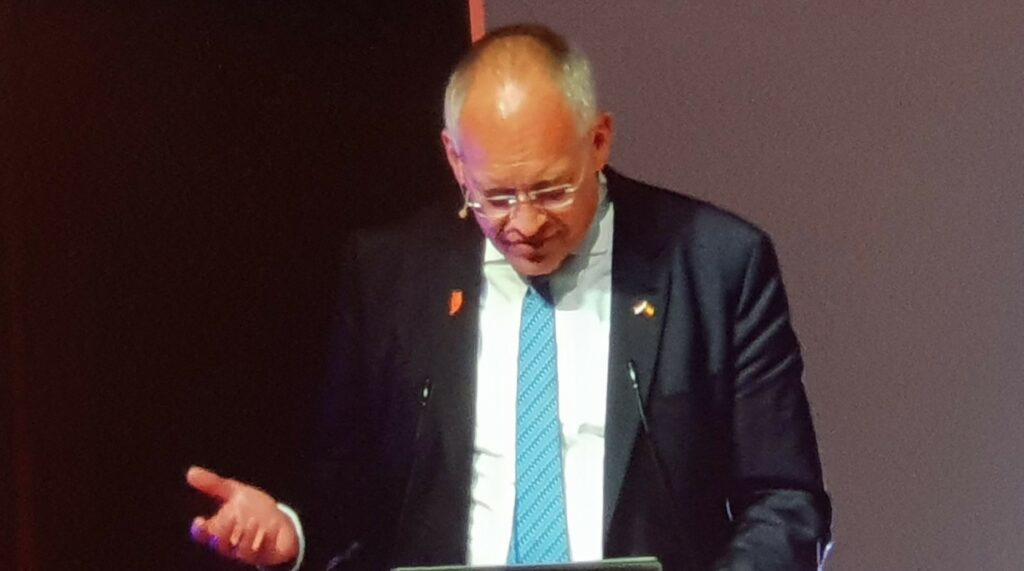
Ladies and gentlemen, I am proud that the Ministry of Health, Welfare and Sport of The Netherlands is part of this continuing tradition of gathering the brightest minds and leaders in European Digital Health, to be inspired by what the future will bring us, and discuss ways to make that future a reality. This year, in beautiful Sitges! Or as the late Johan Kruijff liked to call it: Amsterdam Extra South.
However, I am here today to break with that tradition. To be honest, I have had enough inspiration. I’ve heard enough people talking about leading change for a better future. And I bet you all have too. Digital health is booming, innovation is hot. But in truth, we haven’t solved the big challenges we face today that keep us from reaching the full potential digital health can bring us all.
Challenges like how will we be able to care for the silver tsunami without a big enough workforce. Currently in The Netherlands 1 in 7 people work in healthcare. If we don’t change the current trend by 2050, this will need to be 1 in 3.
Like how we will keep healthcare affordable and accessible with more expensive treatments and more chronically ill people. Every citizen of The Netherlands paid €5.100 on healthcare in 2015. If we don’t change this trend, this will increase to €9.300 by 2040.
And one of the biggest challenges in Digital Health is speaking the same set of languages. Being able to understand and trust each other is essential in leveraging the advantages digital technologies bring to healthcare. Without these basic and very human values, we lose sight of what we are working on.
I believe we should focus these traditional international gathering on celebrating the many different heroes of digital health. The passionate professionals who work tirelessly every day. The relentless patient advocates who share their compelling stories to keep us all on the right track. The rebels who defy the system and disrupt the status quo. The changemakers who see possibilities and have the courage to act on them.
We should celebrate them, learn from them, question them and embrace them.
The one thing we can’t do is ignore them. Because theyarethe change. They invent. They imagine. They explore. They create. They move. And they dance.
Ladies and gentlemen, today I want to celebrate one of my big heroes: the late Niels Schuddeboom.
Niels Schuddeboom, aka ShakingTree
A video of an interview with Niels Schuddeboom plays. This is the transcript.
Niels: Embracing technology always begins with sharing stories, and always begins with taking the time to discuss the risks. Taking the time to discuss the anxieties and the worries. And in that way we will see a landscape in which many more people than today will use technology.
It doesn’t matter to me where resistance comes from, it does matter if you can have an open dialogue about it to solve it. Resistence is a natural thing so we have to dance with it and then it will be solved.
Technology has a huge impact on my life and on my business. I’m an ‘early adopter’ so to speak. It’s really useful for me to be in such technological times. If I wasn’t born in the age of network my life would be totally different, because I wouldn’t be able to work the way I do now. When I can use virtual technology and tools it’s much easier for me to stay focussed on my work and to be easily connected with all kinds of people. It makes me equal to others and technology has a huge impact on how I feel participating in society.
E-health is not about the high and complex technology but about the low technology that can make high impact. I look forward to the moment that I can add my own data to my personal health record.
That I can actually open my personal health record. My dossier is now closed to medical personal. I look forward to the moment that I can swallow a scanning device which scans my body so I can skip the MRI. Which spares a lot of time and energy that you can use in a moment of real personal and emotional crisis. When it’s really necessary to look eachother in the eye.
Times are coming that I can easily check if I have cancer. which is very useful for me because I have a cancer protector gene which is broken. So I need to be regularly checked up by a doctor to check if I’m doing well. But if you ask me how much energy it takes to be in such a process and if it would be useful to have this device to check me up in the home situation it would be a totally different game.
My son is now five months old. He is smarter with technology than I will ever be. I know that upfront. There is no one telling him not to have a personal health record. Or not to collect his health data. Because it will be normal by the time he is old enough to use it. And there are a lot of elderly people now having worries but his generation, the generation of my son when he is 70 years old he will live longer thanks to all the technology he has around him. So we shouldn’t worry too much about technology we should try to keep faith and to move forward.
For over a year, Niels was a valuable member of the Ministry’s Board of Directors, our Chief Experience Officer. As such, he got access to all board meetings, often with a virtual presence.
When dealing with the complex changes required for digital health, Niels chose empathy over distance, humor over judgement and dialog over opinions.
He learned to dance with the system, and be the changehe wanted to see.
Sadly, he passed away from cancer late last year. In his last year, he sought out like-minded people, heroes in their own right, and created a movement of Torchbearers. They are the ones who will bear his torch and carry his fire along with their own. They too are the change.
We even created an award for this honour, the Shakingtree award. He received the first award himself, and he immediately passed it on to one of his heroes.
Ladies and gentlemen, innovation in healthcare is what we call a wicked problem. It is complex, as it involves many different stakeholders with diverging interests. The conservative powers are often very strong, working to keep the status quo.
Governments have a responsibility towards their citizens to accelerate health innovation, so the benefits are available to them at the right conditions. We need to ensure that digital health adds value to patients and keeps citizens healthy. That it enables healthcare professionals to spend their valuable time and knowledge on providing the best possible care at the right place. That all digital communication is trustworthy and safe.
Government alone can never bring the change we need. For this we need the whole ecosystem. And our role is to bring them all together. To show leadership and go from making legislation to kickstarting the broad social movement to empower citizens to become the master of their own health. To bring cold technology to enable warm care. To take healthcare from the waiting room to the living room. With a strong focus on high impact, using proven technology and getting measurable and meaningful results.
These past few years I have talked with many people and visited many organizations and events who show that meaningful digital health is possible. We kickstarted this bottom up movement at the Amsterdam eHealth Week in 2016 during our EU presidency, where we brought the whole ecosystem together and gave patients a big voice on the main stage.
In our national e-health weeks in January 2017 and 2018, over 250 partners all over the country opened their doors to peers, patients and visitors to showcase their working e-health solutions.
In Tallinn, during the Estonian EU presidency, we joined our friends on the main stage to launch the Digital Health Society. This broad movement brings together stakeholders from the whole European digital health ecosystem, to break through the barriers that prevent the free, safe and trustworthy flow of health data.
Just a few weeks ago, we hosted the IHE European Connectathon where over 300 programmers from digital health industry were working together to make their systems interoperable.
And today I am addressing you all here at the joint HIMSS and Health 2.0 conference. Together, we are creating momentum. Momentum for the social movement of health changemakers.
Ladies and gentlemen, modern healthcare is a flourishing ecosystem of interconnected people. An ecosystem needs two things to flourish. First is a good climate that enables the stakeholders to do what they do best. It is the responsibility of government to ensure that the incentives are aligned and that there is an open and level playingfield for everyone -from the current players to the disruptors.
There isn’t a tried and tested model for what this will look like, it is a learning process for everyone. We stimulate this learning by accelerating breakthroughs with so-called Health Deals. We bring people together and will not let them go home until they have committed themselves to creating a breakthrough.
We reduce the risk for digital health investors by creating a seed capital fund, so they accept the possibility of failures more easily. As you all know, failure is the best way to learn.
We call on all stakeholder to report to us all legislation, rules and regulations that are blocking their innovation in today’s practice. As it turns out, 9 out of 10 of these barriers don’t exist in reality, they are misinterpretations or misunderstandings. And the 10thrule often stems from an outdated practice and can easily be removed.
And with the Health Innovation School, we invest in the innovation skills of the healthcare leaders of tomorrow. Here they learn how to become Changemakers and Torchbearers.
By creating a good climate, we are feeding the movement.
The second thing any ecosystem needs is fertile ground. Thatis the foundation on which modern healthcare is built. It is the standards and requirements and legal frameworks that ensure that all communication is safe, secure and trustworthy.
That we know who we are communicating with.
That our communication has not been altered along the way.
That we understand what we actually mean.
And that we can use the data in our own systems.
Therefore, we created a National Health Information Council. A public-private partnership, including patients, doctors, nurses, other health professionals, insurers, hospitals, care institutions, general practitioners and governments. Or as I’d like to call it: we got the whole system in a room. With the Ministry in the role of a system therapist.
Together, we have set ambitious but achievable outcome goals: improving medication safety, improving patients access to their medical data, enabling safe data exchange and improving the quality of data. One time registration at the source and multiple re-use. To reach these goals we need mutual agreed upon standards for information exchange.
Consequently, compliance with these standards becomes part of the definition of what is regarded as good quality care. A major paradigm shift.
Compliance with these standards becomes part of the regular purchasing process of health insurers. And you can only be reimbursed if you comply with these standards. Failure to comply will have real consequences. You will lose your license to operate.
This approach requires trust and commitment from all parties involved. We are trying to realize this by means of a kind of psychological contract or self binding mechanisms. And by setting the open standards for safe and secure information exchange we create a level playing field for the Health IT industry and innovative new health entrepreneurs.
Ladies and gentlemen, it is at conferences like this that the whole digital health ecosystem meets. That is what make these events worthwhile to attend. It is up to us to make this conference a success. We need to go beyond inspiration and networking opportunities, and use the presence of the whole ecosystem and momentum to create concrete breakthroughs. Use the sessions and workshops to make deals to adopt a working solution in your organization, to scale up an emerging but proven innovation, to join a taskforce or working group that will harmonize the exchange of health data.
This is hard work and requires personal commitment. You have to make it small enough to handle and big enough to matter. Matter for your peers, for people like Niels, Marie and Julie, and most of all to yourself.
At the next events, we report and celebrate the progress we have made on these breakthroughs. We renew our commitments for the next steps and apply the lessons learned. And then we move on to the next breakthrough.
The time for observing from the sidelines and waiting for unanimous agreement on the proposed solution is over. If you are not part of the solution, you are part of the problem and I will not invite you to our next events.
With this conference, we have created a unique event that enables you to take responsibility and become the changemakers we need. You have to be the torchbearers shaking the tree. The first followers joining the lonely nut dancing on a hill.
And dance with the system.
Let’s go to work. Think big, act small, start today.
In dit interessante artikel van Dan Rowinski gaat hij in op de groei van het gebruik van wearable technologie en de verwachtingen voor 2016. Wearables beloven veel, maar moeten ook nog bewijzen wat ze waard zijn. Juist omdat de ontwikkelingen zo razendsnel gaan (exponentieel zelfs), is het interessant om dit in de gaten te blijven houden.
In Nederland willen we tot een duurzaam informatiestelsel in de zorg komen. Hiertoe heeft het ministerie van VWS een Informatieberaad in het leven geroepen. Een zorgbreed, bestuurlijk overleg met partijen uit het veld. Doel is, de regie op de samenhang tussen alle ‘losse’ ontwikkelingen te voeren en de belemmeringen uit de weg te nemen. Het eerste beraad vond op 13 oktober jl. plaats.
Evert Sanders, gebruikersvoorzitter IHE Nederland, praat met Herko Coomans, projectleider van het Regiebureau Informatievoorziening Zorg i.o. van het ministerie van VWS, het vroegere Programma Informatiehuishouding op Orde (PrIO). (more…)
Het 3D vraagstuk is actueel. Het behelst de drie decentralisaties op jeugdzorg, participatie van mensen met een handicap en de AWBZ zorg die deels in de gemeentelijke Wet Maatschappelijke Ondersteuning (Wmo) wordt ondergebracht.
Het 3D vraagstuk is vooral een informatievraagstuk: alle noodzakelijke informatie van alle betrokken partijen moet op tijd voor de juiste mensen beschikbaar zijn. Dan is het belangrijk dat alle partijen dezelfde begrippen gebruiken, kerngegevens uit vertrouwde bronnen hergebruiken en communiceren volgens afgesproken standaarden en generieke methoden en voorzieningen. Dat vraagt constante samenwerking en afstemming en aandacht voor aspecten als ontwikkeling, implementatie, beheer en governance. Kortom: een ander niveau van standaardisatie. (more…)
Fancy a cookie?
I use cookies on my website, stored on your own device to remember any preferences you set and load those by default on repeat visits. I do not use cookies to collect or track any of your data, or sell any data your visit to my website may generate.
Opt-out complete; your visits to this website will not be recorded by the Web Analytics tool. Note that if you clear your cookies, delete the opt-out cookie, or if you change computers or Web browsers, you will need to perform the opt-out procedure again.
You may choose to prevent this website from aggregating and analyzing the actions you take here. Doing so will protect your privacy, but will also prevent the owner from learning from your actions and creating a better experience for you and other users.
This opt out feature requires JavaScript.
The tracking opt-out feature requires cookies to be enabled.
Privacy & Cookies Policy
Privacy Overview
This website uses cookies to improve your experience while you navigate through the website. Out of these cookies, the cookies that are categorized as necessary are stored on your browser as they are essential for the working of basic functionalities of the website. We also use third-party cookies that help us analyze and understand how you use this website. These cookies will be stored in your browser only with your consent. You also have the option to opt-out of these cookies. But opting out of some of these cookies may have an effect on your browsing experience.
Necessary cookies are absolutely essential for the website to function properly. This category only includes cookies that ensures basic functionalities and security features of the website. These cookies do not store any personal information.
Functional cookies help to perform certain functionalities like sharing the content of the website on social media platforms, collect feedbacks, and other third-party features.
Performance cookies are used to understand and analyze the key performance indexes of the website which helps in delivering a better user experience for the visitors.
Analytical cookies are used to understand how visitors interact with the website. These cookies help provide information on metrics the number of visitors, bounce rate, traffic source, etc.
Advertisement cookies are used to provide visitors with relevant ads and marketing campaigns. These cookies track visitors across websites and collect information to provide customized ads.